
Key Takeaways
- Only 22 percent use AI productively: For most companies, AI never moves beyond pilots and enthusiastic individual use.
- More than 80 percent of AI projects deliver no business value: The failure rate is high, but the causes are well known and avoidable.
- Up to 20 percent more productivity: Where AI runs across core processes, productivity in those processes rises by about a fifth.
- Only about a third of SMEs use AI at all: Around 36 percent of small and mid-sized companies have adopted it, which leaves a large share of potential untouched.
- Processes before tools: A clear frame of relevant processes and clean data is the precondition for any measurable return.
- Technology is rarely the problem: Projects stall because goals, process understanding and a definition of the benefit are missing.
Introduction
Why do so many AI projects fail to create a real advantage? The answer is sobering. Only 22 percent of companies use AI productively, even though the potential is enormous and the tools have never been more accessible.
Many companies buy new technology in the hope of quick success. Without clean processes and clear goals, that is like buying a home gym that ends up gathering dust in the basement. The equipment is excellent. The habit around it never formed.
In my work with mid-sized companies I keep seeing the same pattern: decisions about AI tools are made on impulse. The wish to keep up with the technology replaces a sound plan for what the technology is supposed to achieve.
This article shows what the productive 22 percent do differently and how you can turn your own AI initiatives into genuine productivity boosters. My guiding principle stays the same, especially with artificial intelligence: think first, then pick the tool.
The 22 Percent Reality
The KPMG Global AI Pulse for the second quarter of 2026 puts it bluntly: only 22 percent of companies use AI in a way that produces measurable productive effects. Everywhere else, AI remains in proofs of concept, isolated experiments and individual use that never becomes part of a process.
At the same time, more than 80 percent of AI projects end without demonstrable business value. Put these two numbers side by side and the picture is clear: the question is no longer whether AI works, but whether organisations are prepared to make it work.
For the German Mittelstand the gap is even wider. Only around 36 percent of smaller and mid-sized companies use AI at all. More than half are still waiting, often because they are unsure where to start or because a first attempt produced frustration rather than results.
Why Technology Is Rarely the Problem
When an AI project stalls, the first suspect is usually the tool. Was it the wrong model? The wrong vendor? Should we have waited for the next version? In most cases these questions miss the point.
The real reasons are organisational. Nobody defined which problem the tool should solve. Nobody owned the result. Nobody described how the current process works before trying to accelerate it with AI. The technology then gets blamed for a gap it never had a chance to close.
A simple test helps: can you name the business number that your AI initiative is supposed to move? Response time in customer service, hours spent on offers, error rate in order entry? If the answer is no, you do not have a project yet. You have a licence.
Clean Up Data and Processes Before the Tool
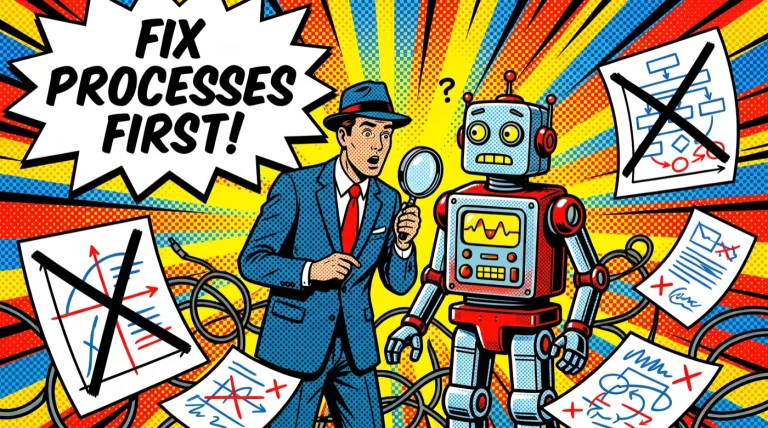
AI accelerates whatever it finds. If it finds a clear process with reliable data, it makes that process faster. If it finds chaos, it produces faster chaos. That is why a clear frame of relevant processes is the precondition for every successful AI deployment.
In practice this means three steps. First, pick one process that matters, for example preparing offers or answering recurring customer questions. Second, write down how it works today, including the sources of information it depends on. Third, make exactly those sources reachable and up to date before any AI touches the process.
This does not require a large data platform. It requires a decision about one use case and the discipline to prepare it properly. Companies that work this way usually see first noticeable results within weeks, not years.
Brief AI Like a New Colleague
The quality of AI output depends directly on the quality of the briefing. Many disappointing results have a simple cause: the instructions were vague, and the expectations behind them were never spoken out loud.
Think of how you would brief a capable new colleague on their first day. You would explain the goal, the context, the audience, the format and the criteria for a good result. AI needs exactly the same information. Prompting like a professional is not a technical skill. It is a management skill.
Teams that learn to brief AI well quickly move from occasional experiments to reliable daily use. That transition, from curiosity to routine, is what separates the 22 percent from everyone else.
How to Measure AI ROI
A positive AI return exists when the measurable productivity gains are clearly larger than the effort for technology, introduction and adaptation. That sounds obvious, but it requires two things many companies skip: a baseline before the project starts and a fixed date to review the result.
Where AI does run across core processes, productivity in those processes rises by about 20 percent on average, according to the KPMG Global Tech Report 2026. That figure is a realistic orientation. It is concentrated in the processes actually covered and should not be treated as a company-wide multiplier.
Measure what changes for the people doing the work: time saved per task, fewer errors, faster responses. Then add the full costs, including training and the time your team spends adapting. If the balance is positive, scale. If it is not, adjust or stop.
Your Next Steps
- Choose one process where AI could save time or reduce errors.
- Document how this process works today and which data it needs.
- Define the business number the initiative should improve.
- Train the team to brief AI clearly, with goal, context and format.
- Measure before and after, and set a fixed review date.
- Scale only what has demonstrably worked.
Mentioned Tools & Resources
- KPMG Global AI Pulse Q2 2026: Survey on productive AI use and the factors behind measurable returns.
- KPMG Global Tech Report 2026: Productivity effects of scaled AI in core processes.
- TJ's Technology Tuesday: Weekly 15-minute digital impulse for C-level leaders, recorded on LinkedIn.
- digital4productivity podcast: The same topics as audio episodes for listening on the go.
Frequently Asked Questions
Why do so many AI projects fail in mid-sized companies?
Most fail because goals and processes were never defined before the tool was introduced. Status and the wish to keep up often replace a plan. Without a clear problem to solve, technology alone delivers little value.
How can I avoid data and process chaos with AI?
Clarify the process and prepare the data it depends on before AI is introduced. Start with one use case, document how it works today and make the required information reachable and current.
What productivity gain can AI realistically deliver?
Where AI runs across core processes, productivity in those processes rises by about 20 percent on average. The precondition is a well-prepared process and a team that knows how to brief the tools.
What are the most common mistakes when introducing AI tools?
Buying tools on impulse, missing goals, no owner for the result and vague briefings. All four lead to frustration instead of productivity and can be fixed before the next project starts.
What makes a positive AI ROI?
A positive ROI exists when measurable productivity gains clearly exceed the costs for technology, introduction and adaptation. That requires a baseline, a target metric and a fixed review date.
How do employees learn to use AI properly?
Through concrete use cases from their own work and training in how to brief AI with goal, context and format. Regular exchange about what works and what does not accelerates the learning curve considerably.
Conclusion
The gap between AI potential and AI results is organisational, not technical. The 22 percent who use AI productively are not using better tools. They chose relevant processes, prepared their data, defined a measurable goal and taught their teams to brief AI well.
None of that requires a large transformation programme. It requires one process, one number and one honest review date. If you would like support with that, I help leaders and teams make AI productive through keynotes, training and C-level sparring. Relevance over gimmicks: think first, then pick the tool.