
Key Takeaways
- Technology enters companies through status, not strategy: The moment the old device looks dated on the golf course, the budget appears.
- 61 percent use AI, fewer than a third profit from it: The gap is not created by the tools. It is created by the question asked before the tools arrive.
- Reach is not the same as revenue: A single thought inflated into two screens of text costs your audience time and rarely attracts the people who hire you.
- AI video editing already works surprisingly well: Forty minutes of raw footage became two usable cuts in a handful of feedback rounds.
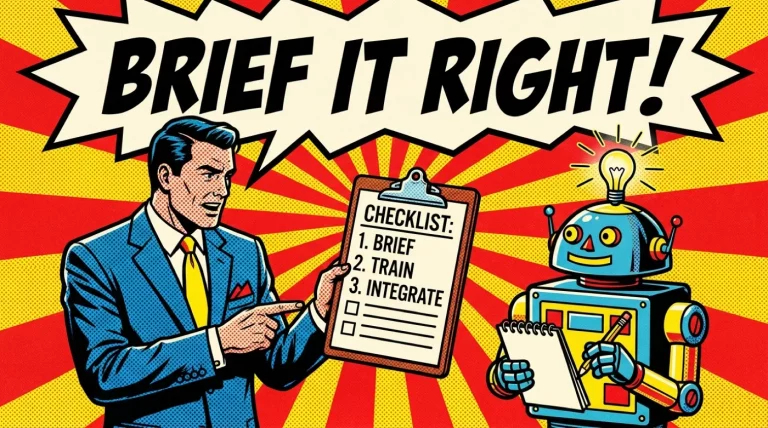
- Treat AI like a new team member: Brief it, review the result, sharpen the instructions. Quality arrives in loops, not on the first attempt.
- Clarity beats depth on stage: Every piece of feedback this week came back to the same point – people want to be understood, not impressed.
Introduction
My motto has been the same for years: switch on your brain first, then the technology. Week 38 confirmed it from several directions at once – on stage, in a hands-on experiment with AI video editing, and in the feedback event organisers sent back.
This article collects the impulses of the week and takes each of them a step further than the short clips could.
How New Technology Really Enters a Company
The official answer sounds impressive: strategic planning, requirement analysis, a business case. The honest answer is far less flattering. At some point it became uncool to show up on the golf course with an outdated device. Shortly afterwards, senior management walked into the office asking for the new, shiny model – in the maximum configuration, of course.
During my years working closely with Apple projects, I received more calls from managing directors asking whether they could get the latest model a few weeks early than calls about security concepts. That is not a criticism of executives. It is an observation about people. Technology decisions are status decisions until somebody offers a better reason.
I regularly meet managers carrying more devices than they can physically handle – let alone actually operate. The practical conclusion is not to fight this effect but to use it. When leadership wants a new tool, that is the ideal moment to ask which specific problem it should solve. Answer that question well and you receive budget and attention in the same conversation.
61 Percent Use AI, Fewer Than a Third Profit From It
"Everybody is doing AI, so we need to do AI too." I hear this sentence in almost every company I visit. Once you notice that even plumbing and heating businesses are running AI projects, nobody wants to be the one still waiting.
The numbers are clear and uncomfortable at the same time. Around 61 percent of companies have AI in use, but fewer than one in three turns it into measurable profit. The difference is not the technology – everybody has access to the same models. The difference is the question that came first. Start with "we need to do something with AI" and you end up with pilot projects. Start with "this process costs us twelve hours every week" and you end up with results.
So before we reach for artificial intelligence, let us start with common sense. And because failures teach more than showcases: look closely at the situations where AI gets things wrong. I regularly lose patience not only with the voice assistant at home but with professional AI systems as well. Knowing the limits is what allows you to use the strengths deliberately.
Enough AI Noise on Social Media
A thought that fits into one sentence gets inflated by AI into two screens of text. That costs me time as a reader. More importantly, it costs your target audience time – and those are exactly the people you wanted to win over.
The standard objection is that algorithms reward longer posts and that reach measurably increases. That is true. But the decisive question is not how many people see your post. It is which people see it. Are they the ones who will book you, hire you or recommend you? Reach without relevance is an expensive statistic.
My own approach: AI rarely writes my text and frequently provides the second opinion. It shortens, it disagrees, it finds the weak spot in the argument. The thought itself has to exist before the tool is opened. Brain first, technology second – that applies on LinkedIn exactly as it applies in the server room.
Making-of: Editing Video With AI
For recording I currently use a compact gimbal camera rather than my phone. Its advantage shows in difficult lighting, where it clearly outperforms the iPhone. The drawback is an extra transfer step and one more device to carry. For a simple talking-head clip the built-in microphone is good enough; at a trade fair such as IFA I switch to a clip-on microphone.
The interesting part is the editing. I had roughly forty minutes of raw footage, recorded as short clips, of which exactly one was unusable. I opened a new session in Claude Code and asked a simple question: what do you need in order to edit video well? The system listed the tools it wanted, then installed and tested them itself. Asked what could be improved, it suggested better lower-third graphics. I handed over my existing design system as the reference for all graphical elements.
Two or three feedback rounds later I had two versions. The first simply joined the clips and removed filler sounds and awkward pauses – that worked really well. The second was a six-minute edit. Is it perfect? No. In one shot the lower third sits closer to me than to my wife although we are both in frame. A professional editor delivers a visibly better result.
But you do not always have the budget, and you do not always have the time. The most promising option is a third one: a professional who knows how to brief the AI. That is my next experiment – analysing the editing patterns of professionally cut videos together with an experienced editor and refining the instructions accordingly. Exactly like working with a new colleague, the quality comes from the loops, not from the first attempt.
What Organisers and Participants Reported Back
Three pieces of feedback arrived this week, and they point in the same direction. The organiser of the EACVA conference highlighted something more interesting than the praise itself: the keynote was delivered in English, and what mattered was not the level of detail but whether German and international guests alike could follow it. Details belong in the masterclass, the bigger picture belongs on stage.
Kim Seeling Smith, an entrepreneur who attended one of the sessions, applied a very practical benchmark: can I use these tips in my own business immediately? That is the same standard I apply to my talks. Knowledge that only pays off after a six-month implementation project is not knowledge for most participants – it is a statement of intent.
The third came from Robert Fedinger, board member of Volksbank Raiffeisenbank Fürstenfeldbruck, after his bank’s new-year event. His point was that the topic of digital transformation spoke directly to the concerns his teams deal with every day. For me, that is the real test of a keynote. Not whether the technology impresses, but whether the people in the room recognise themselves in it.
Mentioned Tools & Resources
- Compact gimbal camera: Noticeably better image quality in difficult lighting than a smartphone, at the cost of an extra transfer step.
- Claude Code: An AI working environment that installs and tests the tools it needs and handles editing jobs across several rounds of feedback.
- Clip-on microphone: Essential in loud environments such as trade fairs; the built-in microphone is fine in quiet rooms.
- Design system as a template: Predefined colours, fonts and lower thirds keep AI-edited videos consistent with your brand.
- Keynote topics: AI and digital transformation in German and English, from keynote to in-depth masterclass.
Frequently Asked Questions
Why do so few companies profit from AI although nearly everybody uses it?
Because adoption usually starts with the tool instead of the problem. Around 61 percent of companies use AI, yet fewer than a third see measurable profit. Successful projects begin with one specific, expensive bottleneck and only then look for the matching technology.
Can AI replace a professional video editor?
Not entirely. Forty minutes of raw footage produced two usable versions, but with visible weaknesses such as imprecise lower-third placement. When budget or time for a professional is missing, the result is still far better than publishing nothing.
How do I brief an AI for video editing?
Treat it like a new colleague. Ask what it needs for the task, hand over your design system as a reference and work in several feedback rounds. Letting it analyse professionally edited reference videos and reuse those editing patterns is particularly effective.
Does using AI to lengthen social media posts actually hurt?
It helps reach and hurts business. Algorithms often favour longer posts, but the extra length costs your audience reading time without adding value. What matters is not how many people see a post, but whether the right ones are among them.
How does new technology actually arrive in companies?
Far more often through status and visibility than through strategy. A device becomes attractive as soon as it turns into the standard in someone's peer group. Use that moment to ask which problem it should solve, so budget and attention pull in the same direction.
What equipment do I need for simple company videos?
A current smartphone covers most situations. In difficult lighting a compact gimbal camera delivers noticeably better images but adds a transfer step. Quiet rooms work fine with the built-in microphone; trade fairs require a clip-on model.
Conclusion
The week shows one pattern from four angles. Technology enters through status, AI enters through peer pressure, long posts enter through the algorithm – and in every case it is the thinking behind them that decides whether anything useful comes out.
My suggestion for the coming week: take a single AI tool you already use and write down which specific problem it is supposed to solve for you. That one line separates the 61 percent who use AI from the third that earns money with it.