Key Takeaways
- Customer service is the biggest AI field: 42 percent of German companies use AI there - more than in any other area.
- Klarna as a cautionary tale: Service staff were replaced and later rehired. Pure cost cutting backfires.
- Three reasons bots annoy people: rigid click paths, no knowledge of your own products, and a dead end with no route to a human.
- What customers actually want: 75 percent want to keep human contact as an option, and only 20 percent reject bots outright.
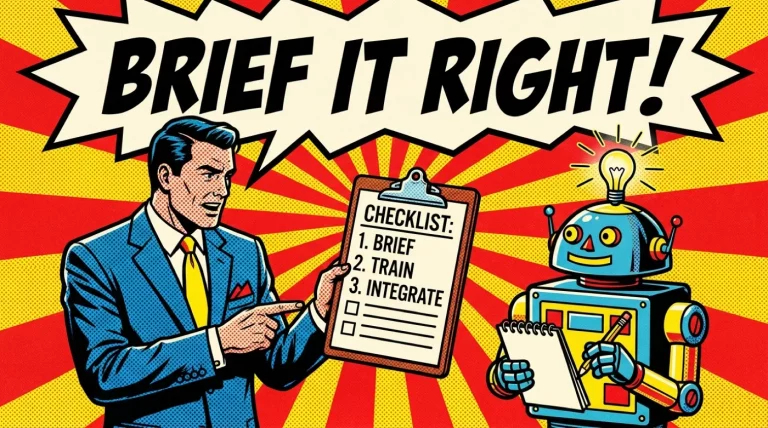
- Five steps to a good bot: a knowledge base with the 50 most common questions, a hybrid handover, transparency, the right metric, and internal before external.
- Transparency is mandatory: The EU AI Act requires that people can tell when they are talking to an AI.
The phone menu everyone remembers
You call your bank. Press 1 for this, 2 for that, 3 for something else. Then you enter your card number and your PIN. You wait in the queue. And when a human finally picks up, you are asked for exactly the same information again. It happens less often these days, which is progress - but it explains why people brace themselves when they see a chat window.
The numbers, and the Klarna example
42 percent of German companies now use AI in customer service, more than in any other function. Honesty requires adding that the driver is usually cost cutting. Klarna is the well-known case: service staff were let go, and afterwards a good number were hired back. The lesson is not that AI does not work in service. It is that the question is not black or white. There are smarter ways to run this than replacing people wholesale.
Why chatbots annoy customers
Three reasons dominate. The rule-based bot from 1988 - or 2015 - with rigid if-this-then-that click paths, which collapses the moment someone phrases a question differently. The clueless bot that does not know its own price list and answers generically. And the dead end: no option to reach a human when the case genuinely needs one.
What customers really think about bots
The picture is more positive than many assume. One in three explicitly welcomes chatbots, and only 20 percent reject them on principle. But 75 percent want to keep human contact as an option, and one in five would happily do without the human if the AI is faster and better. That last condition is the whole point. Meanwhile only 9 percent of Germans broadly trust AI, which is precisely why transparency matters - and why the EU AI Act makes it an obligation.
Five steps to a bot that actually helps
Knowledge base first. Do not dump thousands of documents into it. Start with the 50 most common customer questions. Ask experienced service staff what people really ask and what the good answers are, or mine what your contact centre already recorded for training purposes.
The hybrid principle. Standard cases go to the bot, exceptions go to a human, and the handover must always be available. Standard cases are often resolved faster by a bot anyway - and as the survey shows, if the answer is faster and better, customers are fine with a machine giving it.
Transparency. Say it up front: you are chatting with an AI assistant. Deutsche Telekom called me with an AI agent that opened with hello, this is Tom, the AI assistant, and then booked my fibre installation appointment. It was genuinely good. When someone calls my office, they hear that they are speaking with my AI assistant. That single sentence at the start does the job.
The right metric. Resolution rate and customer satisfaction, not headcount saved. Companies like Telekom and Vodafone measure this continuously and find that satisfaction in the hybrid model is higher than in a purely human service.
Internal before external. One of my clients built a bot to answer Microsoft 365 questions during the rollout. 80 percent of service calls now go through the bot. Employees are happy with it, because it never gets snippy and it answers on a Sunday afternoon when someone is preparing for the week and no human is available.
Efficiency and customer value are not opposites
There is a balance to strike. Delight customers so thoroughly that you no longer earn anything, and you will not be around long enough to help them. Save purely at the customer expense, and they leave. The good cases do both. Airline check-in used to mean queuing at a counter even with hand luggage only. Then came kiosks, then the smartphone. It saves ground staff and it is genuinely more convenient. That is the pattern to aim for with a service bot: faster for the customer, cheaper for you, in that order.
Mentioned Tools & Resources
- Chatbase - platform for external chatbots built on your own content.
- LoyJoy - provider for conversational customer communication in the German-speaking market.
- Microsoft 365 and Copilot - strong for internal knowledge bots, only partly suited to external customer access.
- EU AI Act video course - 14 lessons with a certificate, including the transparency obligations for AI in customer contact.
- Klarna - real-world example of the limits of a purely AI-driven customer service.
Frequently Asked Questions
Why do so many customer service chatbots annoy people?
Three reasons dominate: rigid rule-based click paths, no knowledge of the company own products and prices, and a dead end with no way through to a human.
How many companies use AI in customer service?
42 percent of German companies use AI in customer service, the highest share of any business function. The main driver is usually cost reduction, which on its own rarely succeeds.
What does the hybrid principle mean for chatbots?
Standard cases are handled by the bot, exceptions by a human, and the handover is always available. Customers rate exactly this combination higher than a purely human service.
Do I have to disclose that a chatbot is an AI?
Yes. The EU AI Act sets out a transparency obligation. A clear statement at the start - you are speaking with an AI assistant - satisfies it and builds trust at the same time.
Which metrics matter for a service bot?
Resolution rate and customer satisfaction, not headcount saved. Staff savings may be a welcome side effect, but they are the wrong steering metric.
How do I get started with AI in customer service?
Internal before external. Begin with the 50 most common customer questions from experienced staff. Then test the bot against those questions: if it fails two out of three, it is not ready.
Conclusion
A bad bot saves time internally and costs you customers externally. The formula that works is a solid knowledge base plus a real handover to humans plus honest transparency - measured against resolution rate and satisfaction rather than headcount. Start internally, prove it there, then go external. If you would like a sparring partner to select the right chatbot system for your setup, feel free to get in touch.