“Should we do this with AI or with automation?” – I hear this question in almost every company. The two terms are often lumped together, yet they solve quite different problems. Knowing the difference saves time, money and nerves.
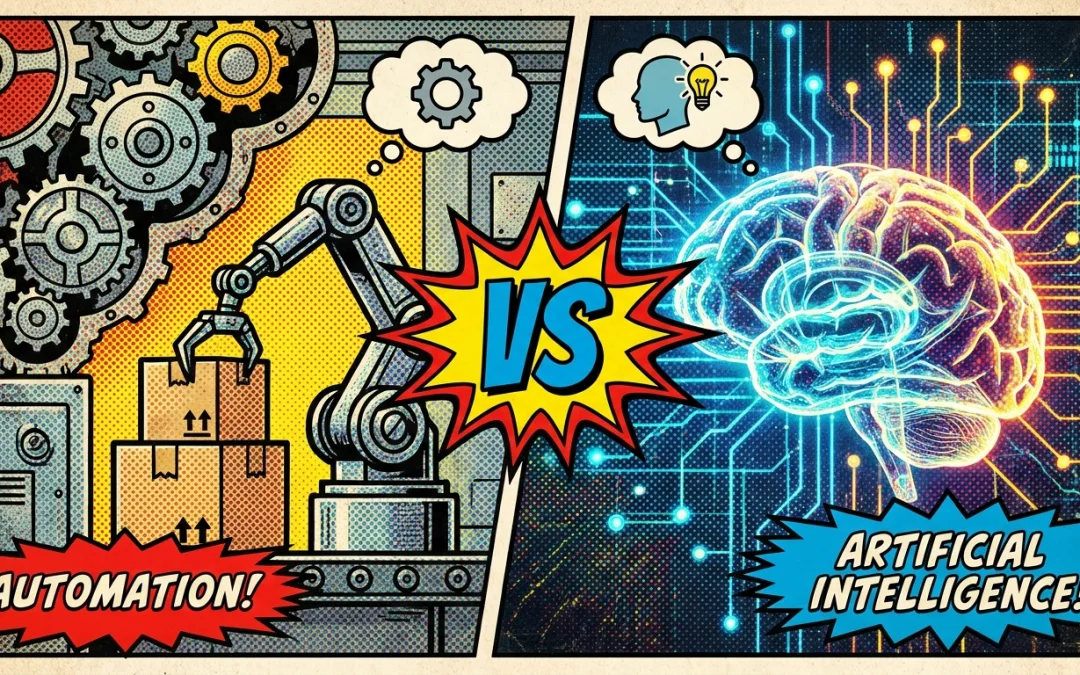
In short: Automation follows fixed rules and reliably handles the same recurring tasks. Artificial intelligence recognises patterns, makes judgements and copes even with new, unstructured situations. You get the biggest leverage when you combine the two.
Automation vs. AI: the comparison at a glance
| Criterion | Automation | Artificial Intelligence |
|---|---|---|
| Core principle | Fixed “if-then” rules | Learns from data, recognises patterns |
| Type of task | Structured & repeatable | Unstructured & variable |
| Example | Filing invoices automatically, forwarding emails | Writing texts, triaging requests, recognising images |
| Handling the unknown | Only what was defined in advance | Also unfamiliar cases |
| Data needs | Low | High (training & context data) |
| Result | Always the same, predictable | Probability-based, can vary |
| Typical tools | Power Automate, Zapier, Make | ChatGPT, Microsoft Copilot, Claude |
| Best for | Clear, repetitive processes | Language, judgement, creativity |
What is automation?
Automation means having software carry out a defined sequence of steps – always in the same way. For example: every incoming invoice is automatically moved to the right folder and the team is notified. The software does not think; it executes what you defined once. Classic tools are Microsoft Power Automate, Zapier and Make.
What is artificial intelligence?
Artificial intelligence goes a step further: it learns from large amounts of data, recognises patterns and makes its own judgements. An AI can summarise a text, triage a customer enquiry by urgency or draft a reply – even if it has never seen that specific case before. Well-known tools are ChatGPT, Microsoft Copilot and Claude.
When should you use which?
Use automation when …
- the process is always the same,
- there are clear, unambiguous rules,
- the result has to be predictable – for example in accounting.
Use artificial intelligence when …
- language, text or images are involved,
- a judgement or assessment is needed,
- the cases differ from one another.
The biggest leverage: combining AI and automation
The most exciting results appear when the two work together – often called “intelligent automation”. A practical example: an automation captures incoming emails, an AI summarises them and suggests a reply, and the automation files the result and notifies the right person. The AI handles the understanding and the automation the doing. Two tools become one seamless, relieving process.
Frequently Asked Questions
What is the difference between automation and artificial intelligence?
Automation carries out fixed, predefined sequences according to clear rules. Artificial intelligence learns from data, recognises patterns and makes its own judgements – even in new, unstructured situations. Put simply: automation does, AI understands.
Is AI a form of automation?
Not directly. AI can make automation smarter, but is not automation itself. Automation follows rigid rules; AI works probability-based and adapts. In practice, the two are often combined.
Do I need programming skills for automation?
Usually no. Modern tools like Power Automate, Zapier or Make work with drag-and-drop building blocks. For simple workflows, a clear goal and a little practice are enough.
When is AI more worthwhile than automation?
Whenever language, text, images or judgement are involved and the cases vary – for example when writing, summarising or triaging requests. For clearly defined, always-identical processes, automation is the better choice.
How do I best get started?
Start with a concrete, recurring annoyance in your daily work. If the process is clearly defined, automate it. If it involves language or judgement, try an AI. The biggest effect comes from combining both.
Conclusion
Automation and artificial intelligence are not rivals but a strong team. Automation ensures reliable processes, AI provides understanding and flexibility. Anyone who uses both deliberately gains noticeable time in their working day – and frees up space for what really matters.